
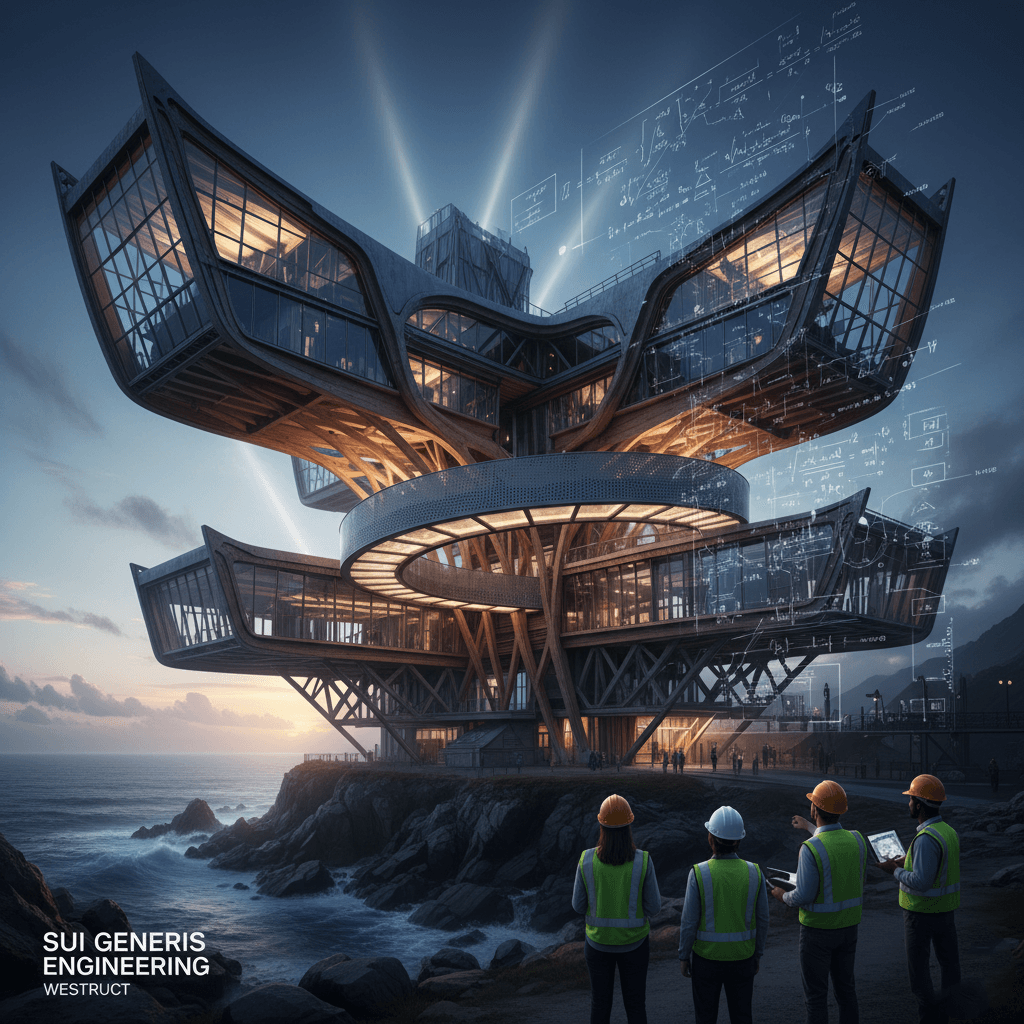
What is Sui Generis Engineering?
Sui Generis Engineering is required when a project, by its very nature, is one-of-a-kind. The term “Sui Generis” is Latin, meaning “of its own kind.” In architecture and construction, it refers to projects that don’t fit into standard categories or follow pre-defined blueprints.
These aren’t your typical home extensions or standard office blocks. A sui generis project could be a complex glass-and-steel art installation, a building with a radical geometric form, or a bespoke cantilevered staircase that appears to float on air.
These projects are exciting and visionary. They are also incredibly complex. They defy simple “off-the-shelf” solutions and demand a deeper level of creative and technical expertise. This is where the true value of sui generis engineering becomes clear, and it’s a challenge our team at WeStruct enthusiastically embraces.
Why Standard Solutions Fail for Sui Generis Projects
When a design is truly unique, you can’t just consult a standard manual or apply a common formula.
- Building Codes: Standard building regulations are written for standard buildings. A unique design often falls into a “grey area,” requiring specialist justification to prove its safety and viability.
- Materials: These projects often push the boundaries of materials, using them in new ways (like structural glass or advanced composites) that lack historical data.
- Construction: The construction sequence itself is often a one-off puzzle. How do you build something that has never been built before?
This is why you need a team that thinks from first principles—a core concept in engineering that means going back to the fundamental physics and mathematics to prove a design, rather than relying on existing rules of thumb.
5 Invaluable Tips for Your Sui Generis Engineering Project
If you have a unique, non-standard project, the path from concept to completion can seem daunting. Here are 5 essential tips to ensure your vision becomes a safe, compliant, and buildable reality.
1. Engage an Engineer Before You’re “Ready”
For a standard project, you might complete your architectural drawings before engaging a structural engineer. For a sui generis engineering project, this is a mistake.
The engineer must be a creative partner from day one. They can provide immediate feedback on the feasibility of a radical design, suggest material alternatives, and identify potential structural challenges before they become expensive problems. Early collaboration saves time, money, and heartache.
2. Embrace Advanced Digital Modelling
Words and 2D drawings are not enough to communicate a truly unique concept. To understand how a complex form will behave under real-world loads (like wind, snow, or crowds), you need advanced digital tools.
We heavily utilise:
- BIM (Building Information Modelling): To create a single, data-rich 3D model that everyone (architects, engineers, fabricators) can share.
- Finite Element Analysis (FEA): This is software that “stress-tests” a digital model, breaking it down into thousands of tiny pieces to see how forces travel through it. It’s essential for proving the safety of a non-standard design.
3. Prioritise a “First Principles” Approach
Ask your engineering partner how they would justify your design to a building control officer. If their answer relies on “what we did last time,” be cautious.
A sui generis engineering specialist will talk about first principles. This means they will use fundamental physics to create new calculations that prove the safety of your specific design. This is crucial for gaining regulatory approval for innovative concepts, such as those found on pioneering design hubs like Dezeen.
4. Create a Plan for “Buildability”
A beautiful 3D model is useless if it can’t be fabricated and assembled on-site. The “buildability” of a project is a key engineering challenge.
- How will a 10-tonne bespoke steel beam be lifted into place?
- What are the tolerances (the tiny margins of error allowed) for a custom glass panel?
- In what order must components be assembled?
Your engineer should be thinking about the construction and fabrication sequence from the very beginning. This plan, often called a “Method Statement,” is a core part of the sui generis engineering design package.
5. De-Risk the Project with Clear Communication
In unique projects, uncertainty is the biggest risk. You can’t eliminate all uncertainty, but you can manage it. Clear, proactive communication is your best tool.
Your engineering partner should act as a translator, explaining complex technical challenges in simple terms. They should be transparent about risks and work with the entire team to find solutions. This collaborative approach, which is central to our philosophy at Westruct, ensures that stakeholders, architects, and contractors are always aligned.
How WeStruct Handles Sui Generis Engineering
We thrive on the projects that others find too complex. Our approach to sui generis engineering is built on a foundation of collaboration and technical excellence.
- We Listen First: We start by understanding your architectural vision, no matter how unconventional.
- We Analyse Deeply: We deploy advanced structural analysis and BIM tools to test, validate, and refine your design.
- We Justify Clearly: We provide the robust calculations and reports needed to satisfy building regulations, navigating bodies like the UK Planning Portal.
- We Partner to the End: We work alongside architects and fabricators to ensure the design intent is realised beautifully and safely.
You can learn more about our core structural engineering services and how they apply to unique builds.
Your Vision, Our Expertise
A sui generis project is, by definition, a journey into the unknown. But it doesn’t have to be a gamble. With the right engineering partner, your unique vision can be translated into an exceptional, enduring, and safe structure.
If you have a one-of-a-kind concept, a challenging conversion, or a design that defies easy classification, we want to hear about it.
Contact WeStruct today to discuss your sui generis engineering project.