
Skip to content
  • Home
  • Articles
  • About us
    • Our Story
    • Our Values
    • Our Clients
    • Our Reviews
  • Projects
  • Services
    • Our Services
    • Architectural Design Technology
    • Structural Engineering Design
    • Infrastructure Design
    • Planning Permission
    • Flood Risk Assessments
    • Building Regulation/Control
    • Construction
    • Substation Design & Engineering
    • Temporary Work Design
  • Contact
  • Home
  • Articles
  • About us
    • Our Story
    • Our Values
    • Our Clients
    • Our Reviews
  • Projects
  • Services
    • Our Services
    • Architectural Design Technology
    • Structural Engineering Design
    • Infrastructure Design
    • Planning Permission
    • Flood Risk Assessments
    • Building Regulation/Control
    • Construction
    • Substation Design & Engineering
    • Temporary Work Design
  • Contact
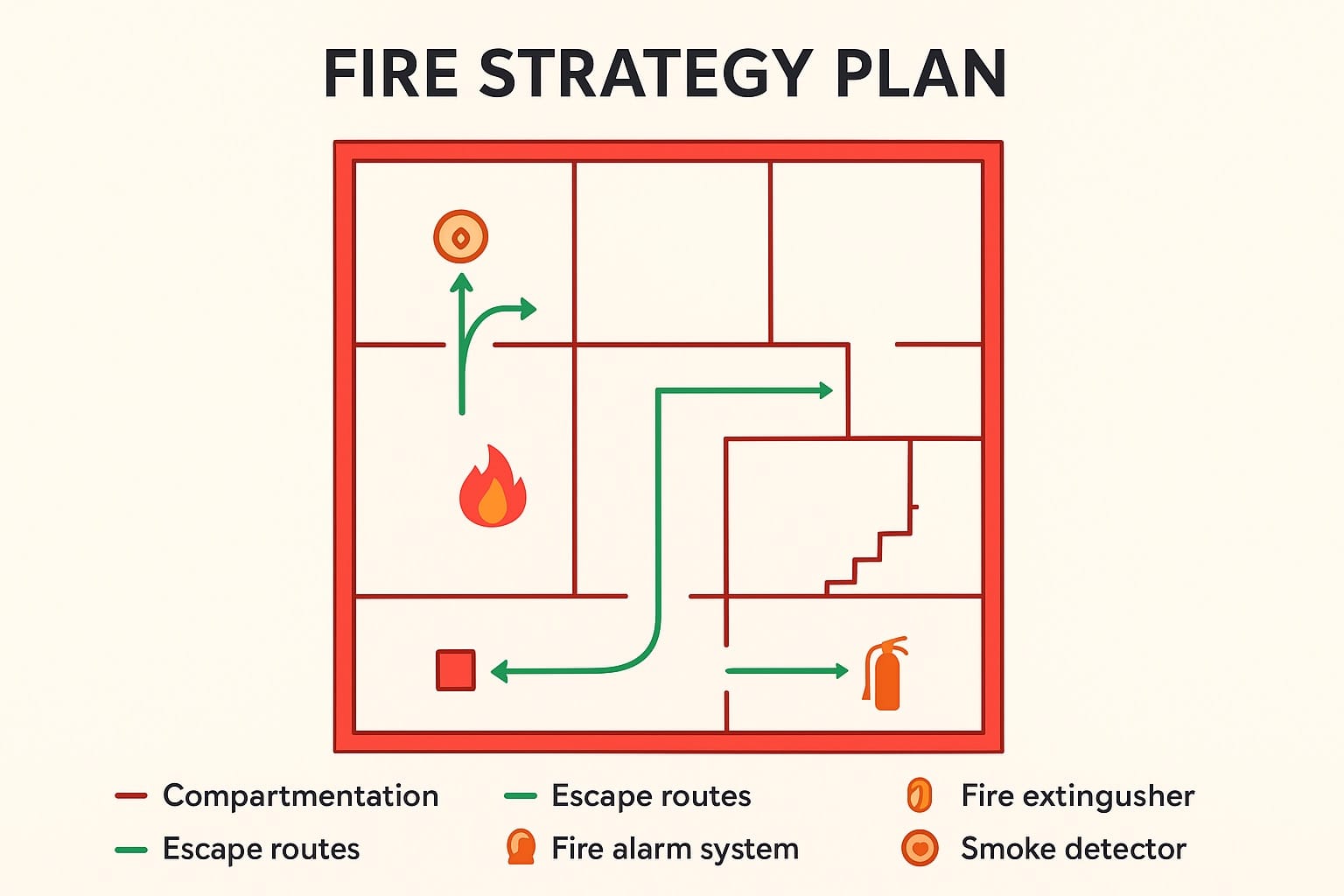
Fire strategy plan diagram showing compartmentation, escape routes, fire alarm system, smoke detectors, and fire extinguisher locations in a building.

Fire Risk Assessment & Building Regulation Part B Guide

A Fire Risk Assessment (FRA) is a legal requirement in the UK and plays a key role in ensuring safety. Under Building Regulation Part B, buildings must meet fire safety standards for warning systems, escape routes, fire spread prevention, and emergency access. This guide explains how a compliant FRA supports Part B requirements and protects both people and property.


1. What Is Building Regulation Part B?

  • Scope: Applies to dwellings (Volume 1) and non-dwellings (Volume 2).

  • Covers Requirements B1–B5: warning systems, escape routes, fire spread, and access for fire services.

  • Guidance is flexible: Approved Document B suggests common methods, but alternatives may be used if they meet equivalent safety standards.


2. How to Carry Out a Fire Risk Assessment (Part B Focus)

  1. Identify fire hazards (ignition sources, fuels).

  2. Identify people at risk (occupants, vulnerable groups).

  3. Review existing fire safety measures (alarms, detectors, doors).

  4. Check escape routes (B1) for safety and compliance.

  5. Assess fire spread (B2–B4) inside and outside the building.

  6. Ensure fire service access (B5) is available.

  7. Recommend improvements and document findings.


3. Why Compliance Matters

  • Legal duty under the Fire Safety Order.

  • Protects lives and property.

  • Demonstrates regulatory compliance and builds confidence.


A well-documented Fire Risk Assessment aligned with Building Regulation Part B ensures legal compliance and safeguards lives. By focusing on escape, prevention, and emergency access, you create safer buildings while meeting regulatory expectations.

WeStruct provide multidisciplinary civil and structural engineering design services, with a diverse team of Architects, Structural Engineers, Civil Engineers, Surveyors and Construction Specialists. 

Architectural-Technology2-_jt49MN4
Architectural-Technology2-1ThL_NGw
Architectural-Technology2-4Zic-hVg
Architectural-Technology2--8ZB3lc0
Architectural-Technology2-CJsnJ4xM
Architectural-Technology2-hXgeWrVk
Architectural-Technology2-JTCzAfDI
Our Services
  • Architectural Design Technology
  • Structural Engineering Design
  • Infrastructure Design
  • Planning Permission
  • Building Regulation/Control
  • Construction
About us
  • Our Values
  • Our Clients
  • Our Reviews
Contact us
  • 07480 111132
  • 07480 111132
  • [email protected]
  • Birmingham B23 7HS, UK

Copyright © 2020 – 2025 WeStruct

Company No. 13473256

Developed by WebKeep

  • Home
  • Articles
  • About us
    • Our Story
    • Our Values
    • Our Clients
    • Our Reviews
  • Projects
  • Services
    • Our Services
    • Architectural Design Technology
    • Structural Engineering Design
    • Infrastructure Design
    • Planning Permission
    • Flood Risk Assessments
    • Building Regulation/Control
    • Construction
    • Substation Design & Engineering
    • Temporary Work Design
  • Contact