
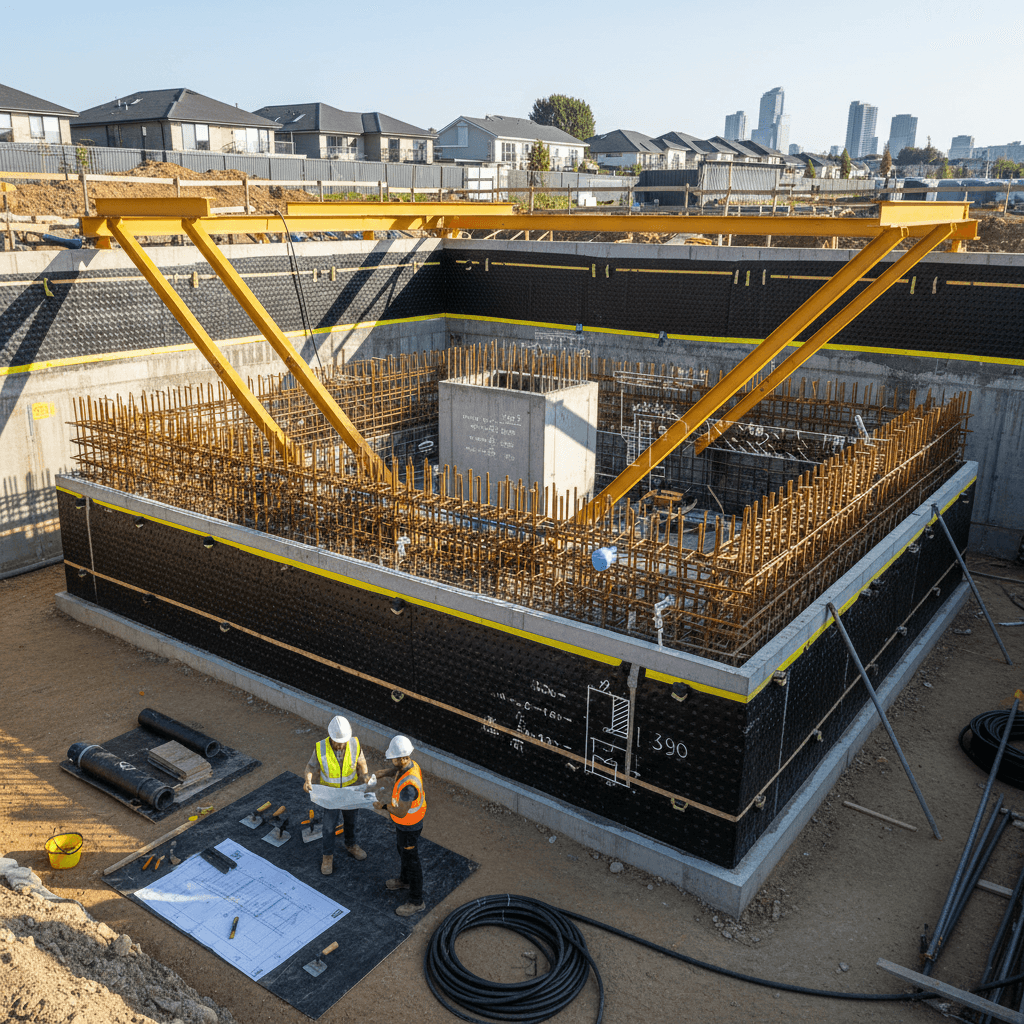
Mastering Basement Structural Design
Basement structural design is widely considered one of the most complex challenges in residential and commercial engineering. Unlike a standard extension where you build up, a basement requires you to dig down, fighting against gravity, soil pressure, and groundwater.
Whether you are planning a luxury subterranean living space, a home cinema, or a functional storage cellar, the success of the project hinges entirely on the engineering. A poorly designed basement can lead to catastrophic structural failure, damp issues, or legal battles with neighbours.
At WeStruct, we specialise in navigating these complexities. We ensure that your excavation is safe, your walls are robust, and your property remains watertight. This guide explores the essential components of professional basement structural design and why it is indispensable for your project.
Why Basement Structural Design is Unique
Building underground introduces forces that don’t exist above ground.
Lateral Earth Pressure: The soil around your basement pushes against the walls. This force increases with depth.
Hydrostatic Pressure: If the water table rises, water pushes against the floor and walls with immense force, trying to lift the building up (buoyancy) or crack the walls.
Surcharge Loads: The weight of nearby buildings, vehicles, or roads adds extra pressure to the excavation walls.
A robust basement structural design must calculate these forces with precision to prevent collapse and ensure longevity.
Key Phases in Engineering a Safe Basement
Creating a safe underground space involves several distinct engineering stages. We handle each of these to ensure a seamless build.
1. Site Investigation and Soil Analysis
Before a single shovel hits the ground, we must understand what we are digging into. Is it solid clay, loose sand, or waterlogged gravel?
Soil Mechanics: Different soils exert different pressures. Clay expands when wet, while sand can wash away.
Water Table: Knowing the groundwater level is critical for the waterproofing strategy.
We use data from geotechnical surveys to inform the basement structural design, ensuring the calculations reflect the real-world conditions of your site.
2. Designing the Retaining Walls
The walls of a basement are not just partitions; they are dams holding back the earth. The structural solution often depends on the site constraints.
Reinforced Concrete: The most common solution, offering high strength and water resistance.
Piled Walls: Used when digging close to boundaries or existing structures to minimize vibration and movement.
Underpinning: Essential if you are extending a basement beneath an existing house. We design the sequence of pins to support the building above while excavation occurs.
You can learn more about our specific approach to Retaining Wall solutions on our dedicated service page.
3. Temporary Works and Propping
The most dangerous phase of basement construction is the excavation itself. Before the permanent walls are finished, the hole must be supported to prevent it from caving in. This requires a separate “Temporary Works” design. We calculate the propping systems—giant steel struts that hold the earth back while the contractors work. This is a critical safety requirement for satisfying the Health and Safety Executive (HSE).
4. Waterproofing Integration
In modern basement structural design, structure and waterproofing are inseparable. We follow the British Standard BS 8102:2022, which outlines protection against water from the ground.
Type A (Barrier): External tanking membranes.
Type B (Integral): Water-resistant concrete (often with water bars at joints).
Type C (Drained): Cavity drain systems that manage water ingress.
Often, a combination of these is required to offer a robust guarantee. We work closely with waterproofing specialists to ensure the rebar layout accommodates these systems.
Managing Risks to Existing Structures
One of the biggest concerns for clients—and their neighbours—is the risk of movement. Digging a hole next to a building can cause it to settle or crack. Our basement structural design includes a “Party Wall Impact Assessment.” We calculate the predicted ground movement and design the stiffness of the basement to keep this within safe limits.
For complex projects involving older properties, we may recommend a preliminary Structural Inspection to assess the condition of the existing foundations before work begins.
Why Choose WeStruct for Your Basement?
Basements are classified as high-risk projects. They require a “Sui Generis” (unique) approach where off-the-shelf designs simply won’t work.
Compliance: We ensure full compliance with Building Regulations Part A (Structure) and local planning policies, which are often strict regarding basements.
Coordination: We coordinate with architects to hide unsightly beams and maximize ceiling height.
Peace of Mind: Our calculations are backed by professional indemnity and rigorous checking processes.
For further reading on the planning permissions required for basements, the Planning Portal provides excellent statutory guidance.
Conclusion
A basement can transform a property, unlocking vast amounts of space and value. However, the line between a dream space and a structural nightmare lies in the quality of the engineering. By investing in professional basement structural design, you are protecting your asset, your family, and your neighbours.
Ready to dig deep? Contact WeStruct today to discuss the feasibility and design of your basement project.